
Digital Infrastructure Architecture at HK TIKGRAM TECHNOLOGY LIMITED

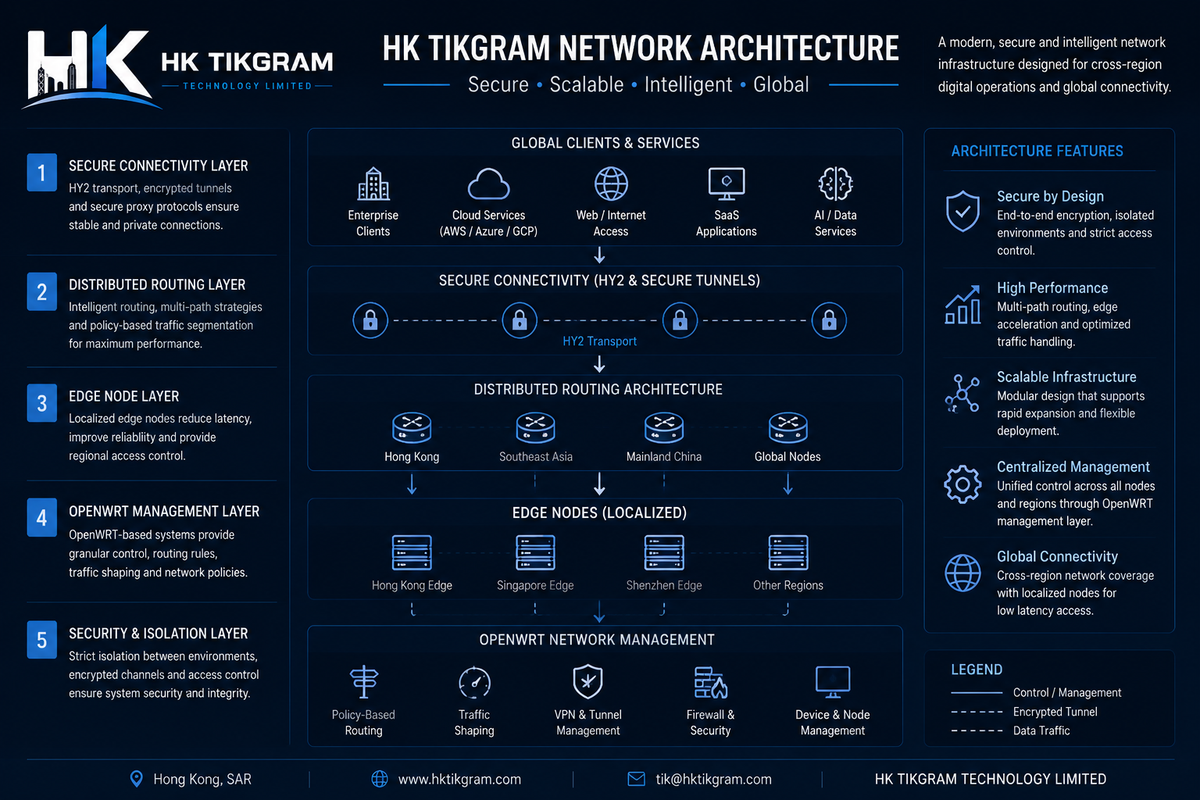
As digital operations become increasingly distributed across regions and platforms, modern businesses require more than traditional network setups. They need resilient, flexible, and intelligent infrastructure systems that can adapt to changing environments while maintaining stability and security. At HK TIKGRAM TECHNOLOGY LIMITED, we focus on building such systems through a layered architecture approach that integrates networking, tunneling protocols, and edge computing principles.
Our infrastructure design is built around three core components: secure connectivity, distributed routing, and controllable network segmentation. These principles allow us to create a system that is not only efficient but also adaptable to complex cross-border operational requirements.
1. Secure Connectivity Layer
The foundation of our system is a secure transport layer that ensures all traffic between nodes remains encrypted and stable. We utilize modern tunneling technologies such as HY2-based transport mechanisms and secure proxy protocols to establish encrypted communication channels between distributed endpoints.
This layer is designed to handle unstable network environments while maintaining low latency and high throughput. By abstracting physical network limitations, we are able to ensure consistent connectivity across regions such as Hong Kong, Southeast Asia, and mainland China.
2. Distributed Routing Architecture
Above the transport layer, we implement a distributed routing system that intelligently directs traffic based on destination, latency, and policy rules. This includes multi-path routing strategies and region-based traffic segmentation.
For example, different types of traffic—such as enterprise services, AI workloads, or external platform access—are routed through dedicated network paths. This ensures both performance optimization and operational isolation, reducing cross-service interference and improving overall system reliability.
3. Edge Control and Local Nodes
To further improve performance and control, HK TIKGRAM deploys localized edge nodes in strategic regions. These nodes act as intermediate processing and routing points, reducing dependency on a single centralized system.
Edge nodes are particularly important in environments with high network variability. They allow us to maintain consistent service quality even when upstream connections fluctuate. In addition, they provide flexibility for implementing localized policies, caching strategies, and access controls.
4. OpenWRT-Based Network Management Layer
At the management layer, we utilize OpenWRT-based systems to provide granular control over network behavior. This includes traffic shaping, policy-based routing, and device-level segmentation.
OpenWRT allows us to unify different network components under a single control framework, making it possible to manage complex routing rules in a structured and maintainable way. It also enables rapid deployment of new configurations across multiple nodes.
5. Security and Isolation Design
Security is a core principle of our architecture. We implement strict separation between internal systems, client-facing services, and experimental environments. Each layer is isolated to prevent unintended interactions and ensure system integrity.
Access control policies, encrypted tunnels, and segmented routing rules work together to maintain a secure operational environment. This design ensures that sensitive infrastructure remains protected while still allowing flexibility for development and testing.
6. System Philosophy
The guiding philosophy behind HK TIKGRAM’s infrastructure design is simple: stability first, flexibility second, and complexity only when necessary.
We avoid unnecessary architectural overhead and focus on practical, production-oriented solutions that can operate reliably under real-world conditions. Every component is designed with maintainability and scalability in mind.
Conclusion
HK TIKGRAM TECHNOLOGY LIMITED is actively developing a modular, distributed infrastructure system designed for modern cross-regional digital operations. By combining secure transport layers, intelligent routing systems, and edge-based architecture, we aim to build a resilient foundation for global digital connectivity.
Our long-term direction is to evolve this architecture into a fully integrated digital ecosystem capable of supporting automation, AI workloads, and enterprise-grade network operations.